
If you’re trying to understand how to generate leads consistently, the answer isn’t simply sending more emails, making more calls, or building bigger prospect lists.
Every business wants more leads.
But more leads do not automatically create more revenue.
A company can generate hundreds of prospects and still struggle to grow because the real problem is often what happens before and after a lead enters the pipeline.
The wrong audience is targeted. The offer is unclear. The message sounds like everyone else’s. Follow-up is inconsistent. Opportunities disappear inside the CRM.
Learning how to generate leads effectively requires more than finding people who might buy from you.
You need a system that turns the right prospects into qualified opportunities and ultimately into revenue.
What Is Lead Generation?
Lead generation is the process of identifying and attracting potential customers who may have a need for your product or service.
For a B2B company, leads can come from channels such as:
- Cold email
- LinkedIn outreach
- Referrals
- SEO
- Content marketing
- Paid advertising
- Networking
- Strategic partnerships
- Events
- Website inquiries
The channel matters, but it is only one part of the process.
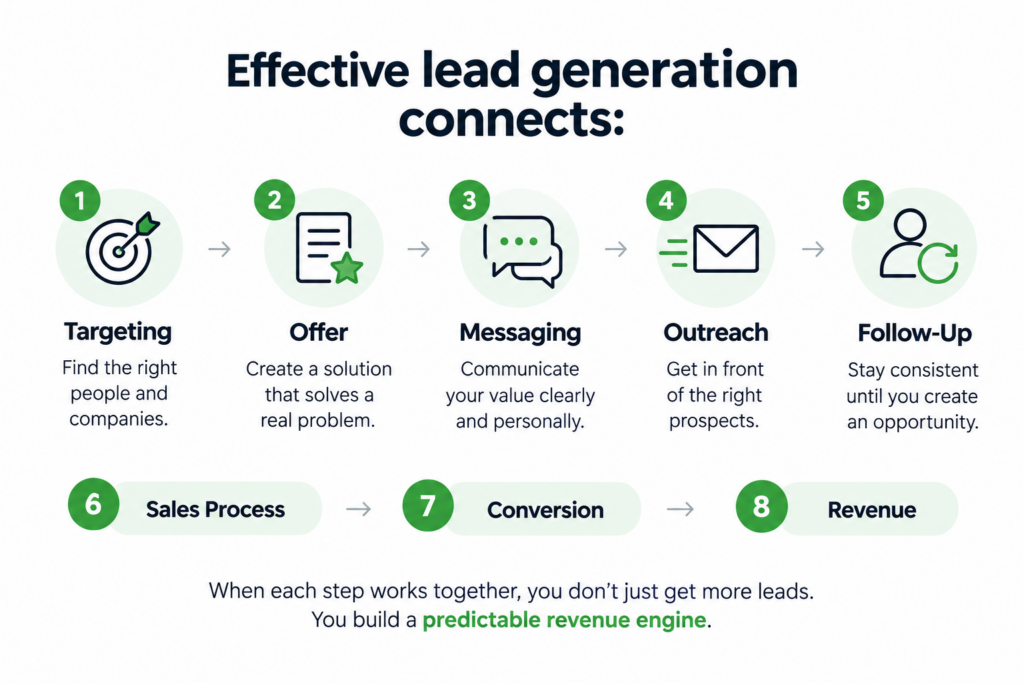 When one part breaks, revenue starts leaking.
According to HubSpot’s lead generation resources, businesses can use multiple strategies and channels to attract prospects and move them toward becoming customers.
For a deeper explanation of the lead generation process, see HubSpot’s Lead Generation Guide.
1. How to Generate Leads by Defining Your Ideal Customer Profile
Learning how to generate leads starts with knowing exactly who you want to reach.
Before asking how to generate more leads, ask a more important question:
Who exactly should we be generating?
One of the biggest mistakes businesses make is targeting too broadly.
Instead of saying:
“We work with small businesses.”
Get specific.
Define characteristics such as:
Industry: Who receives the most value from your solution?
Company size: Is your best customer a 20-person company or a 2,000-person organization?
Revenue: What level of company can realistically afford and benefit from your solution?
Decision-maker: CEO, Founder, VP of Sales, Head of Marketing, COO?
Problem: What expensive problem are they already experiencing?
Trigger: What would cause them to look for a solution now?
Better targeting doesn’t just generate more leads.
It generates better opportunities.
2. Identify the Problem Before Building the Offer
Your prospects aren’t looking for your service.
They’re looking for a solution to a problem.
A founder may not wake up thinking:
“I need a revenue operations consultant.”
They may be thinking:
“Why aren’t our leads converting?”
“Why does revenue disappear whenever referrals slow down?”
“Why aren’t our salespeople booking enough meetings?”
“Why do opportunities keep dying after the proposal?”
That’s where effective lead generation begins.
Understanding how to generate leads means understanding the problems that cause the right prospects to start looking for a solution.
Identify the problem your customer already recognizes and connect your offer directly to solving it.
3. Create an Offer Worth Responding To
Knowing how to generate leads is not enough if your offer gives prospects no compelling reason to respond.
One of the biggest revenue leaks in B2B sales happens when companies successfully reach prospects but fail to communicate why those prospects should care.
Compare:
“We help businesses grow through sales and marketing solutions.”
With:
“We’ll identify where qualified opportunities are leaking out of your pipeline and show you what we’d fix first.”
The second creates curiosity because it addresses a specific business problem.
Your offer should answer four questions quickly:
What problem do you solve?
Who do you solve it for?
What outcome can you help create?
Why should the prospect care now?
If those answers aren’t clear, generating more leads can simply mean generating more people who ignore you.
4. Build a Targeted Prospect List
Once your ICP is clear, build your prospect list around those characteristics.
Don’t chase volume for the sake of volume.
A list of 500 highly relevant companies can be far more valuable than 10,000 random contacts.
Look for companies experiencing potential buying signals such as:
- Hiring salespeople
- Entering new markets
- Launching new services
- Raising capital
- Expanding locations
- Changing leadership
- Growing rapidly
- Posting sales or growth-related roles
These signals can give your outreach context.
Instead of asking:
“Who can we contact?”
Ask:
“Who is most likely to need what we solve right now?”
That difference matters.
5. How to Generate Leads Through Multiple Channels
There is no single answer to how to generate leads for a B2B business.
Depending entirely on one source creates unnecessary risk.
A stronger B2B lead generation strategy combines multiple channels.
Outbound Lead Generation
Identify companies that fit your ICP and proactively start conversations through email, LinkedIn, calling, and other appropriate channels.
Inbound Lead Generation
Create useful content around problems your buyers are already searching for.
Content can target searches such as:
- How to generate leads
- How to generate B2B leads
- How to build a sales pipeline
- Why leads aren’t converting
- How to improve sales conversion
Referrals
Referrals are valuable, but they shouldn’t be your entire growth strategy.
A healthy revenue engine allows referrals to accelerate growth rather than determine whether growth happens at all.
Strategic Partnerships
Build relationships with companies serving the same customers without directly competing with you.
The strongest businesses aren’t simply doing outreach.
They’re building an ecosystem that continuously creates opportunities.
6. Personalize Your Message Around the Prospect
Personalization isn’t:
“Hi John, I noticed you’re the CEO of ABC Company.”
That’s information.
Real personalization demonstrates relevance.
For example:
“I noticed you’re expanding your sales team. When companies reach this stage, one issue we often see is lead generation increasing without the follow-up and pipeline infrastructure scaling with it.”
Now you’ve connected something happening inside their business with a potential problem.
That’s much stronger than simply inserting someone’s first name into a template.
When businesses ask how to generate leads from outbound outreach, messaging is often one of the first areas worth examining.
7. Build a Follow-Up System
Companies learning how to generate leads often overlook what happens after the first contact.
This is where potential revenue can disappear.
A company contacts a prospect once.
Maybe twice.
Then stops.
But prospects don’t always ignore outreach because they’re uninterested.
They may be busy.
The timing may be wrong.
Another priority may have appeared.
They may have read the message and forgotten to respond.
Your lead generation system therefore needs structured follow-up.
A simple sequence could include:
Day 1: Initial outreach
Day 3: Follow-up with additional context
Day 7: Provide something valuable
Day 14: Approach the problem from another angle
Day 30+: Continue nurturing when appropriate
The objective isn’t to annoy prospects.
It’s to remain relevant until timing and need align.
8. Don’t Stop Measuring at Meetings Booked
A lead generation campaign can look successful while producing very little revenue.
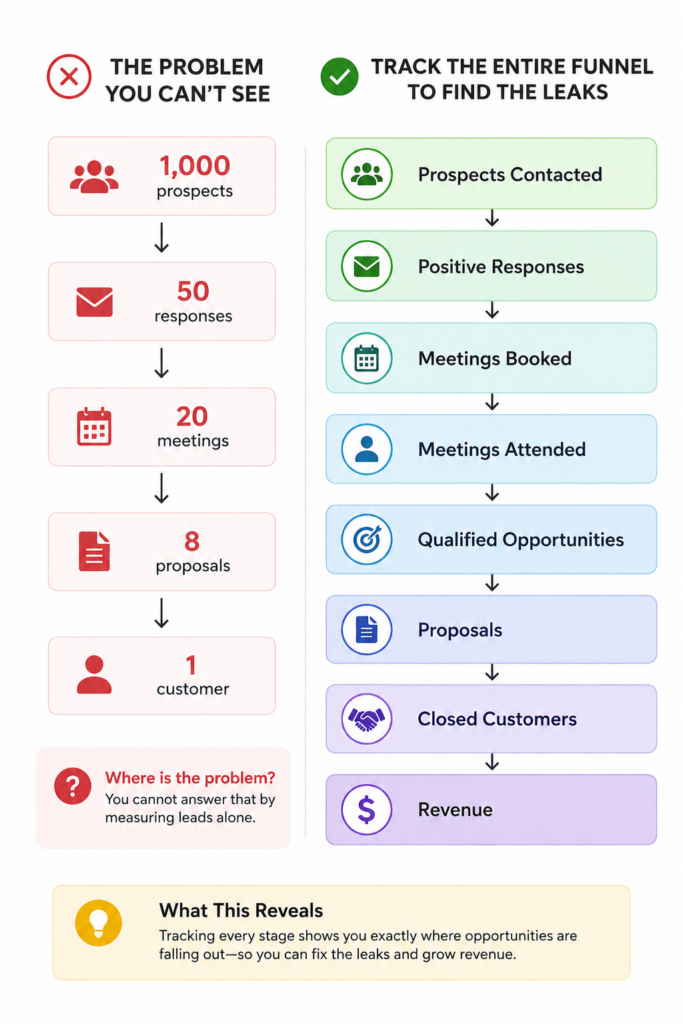
Now you can identify where revenue may be leaking.
If you’re getting responses but few meetings, examine your CTA.
If you’re getting meetings but few qualified opportunities, examine your targeting.
If you’re getting qualified opportunities but few sales, examine discovery, positioning, proposals, and follow-up.
This is the difference between lead generation and revenue generation.
9. Fix Revenue Leaks Before Generating More Leads
Before deciding how to generate leads at a higher volume, determine whether your existing pipeline is already leaking opportunities.
Imagine pouring water into a bucket with five holes.
Would your first solution be to pour more water into it?
Probably not.
Yet businesses often do exactly that with sales.
Pipeline is weak?
Generate more leads.
Revenue is down?
Generate more leads.
Salespeople aren’t closing?
Generate more leads.
Sometimes the correct answer is more leads.
Other times, the business already has opportunities but is losing them somewhere inside the revenue process.
Before increasing volume, investigate:
- Lead quality
- Targeting
- Messaging
- Response rates
- Meeting conversion
- Sales qualification
- Proposal conversion
- Follow-up
- CRM management
- Customer retention
Fixing one major revenue leak can sometimes create more growth than simply doubling outreach volume.
10. Turn Lead Generation Into a Predictable Revenue System
Ultimately, learning how to generate leads should lead to a bigger question:
How do we build a repeatable system that consistently creates qualified opportunities and converts them into revenue?
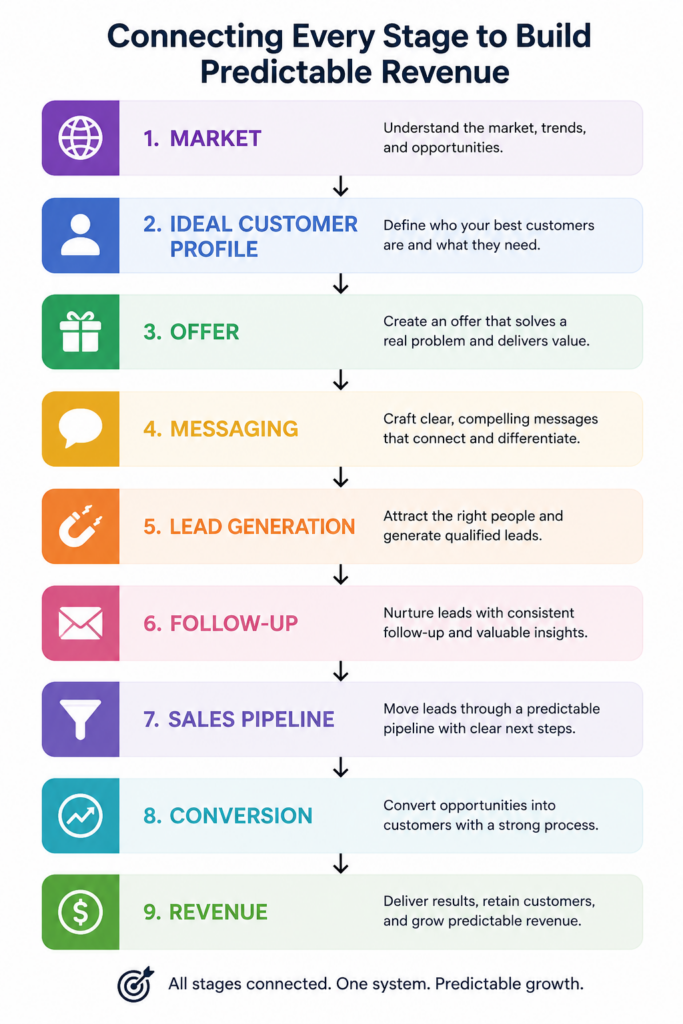
When those pieces operate independently, growth can become unpredictable.
When they operate as one system, you begin building a real revenue engine.
Lead Generation Is Only the Beginning
Understanding how to generate leads is important.
But leads aren’t the finish line.
Revenue is.
If your company is generating activity but revenue still feels unpredictable, the problem may not be the number of leads entering your pipeline.
There may be a leak somewhere between attention and revenue.
That’s exactly what we look for at Seven Circles System.
We help businesses identify gaps across targeting, positioning, messaging, outreach, follow-up, and pipeline management that may prevent qualified opportunities from becoming predictable revenue.
Before spending more money generating leads, find out where your existing revenue system may be leaking.
Find Your Revenue Leaks
Take the Seven Circles Revenue Leak Assessment to identify where opportunities may be falling out of your revenue system and what to fix first.
Explore Our Latest Articles:
5 Best Sales Software for Small Business: What Actually Works
7 Service Business Lead Generation Challenges (And Fixes)
LinkedIn vs Cold Email for B2B Service Firms: Which One Actually Books Meetings