
Service business lead generation challenges usually get blamed on tactics. Your calendar looks fine this month. Next month is the problem, and you already know it. Most service business lead generation challenges are not about which channel you use. They are about the absence of a system that runs whether or not you personally chase it.
This is the gap founders hit around the same revenue ceiling. You built the business on relationships, referrals, and reputation. That got you here. It will not get you to the next stage, because none of those things scale on a schedule.
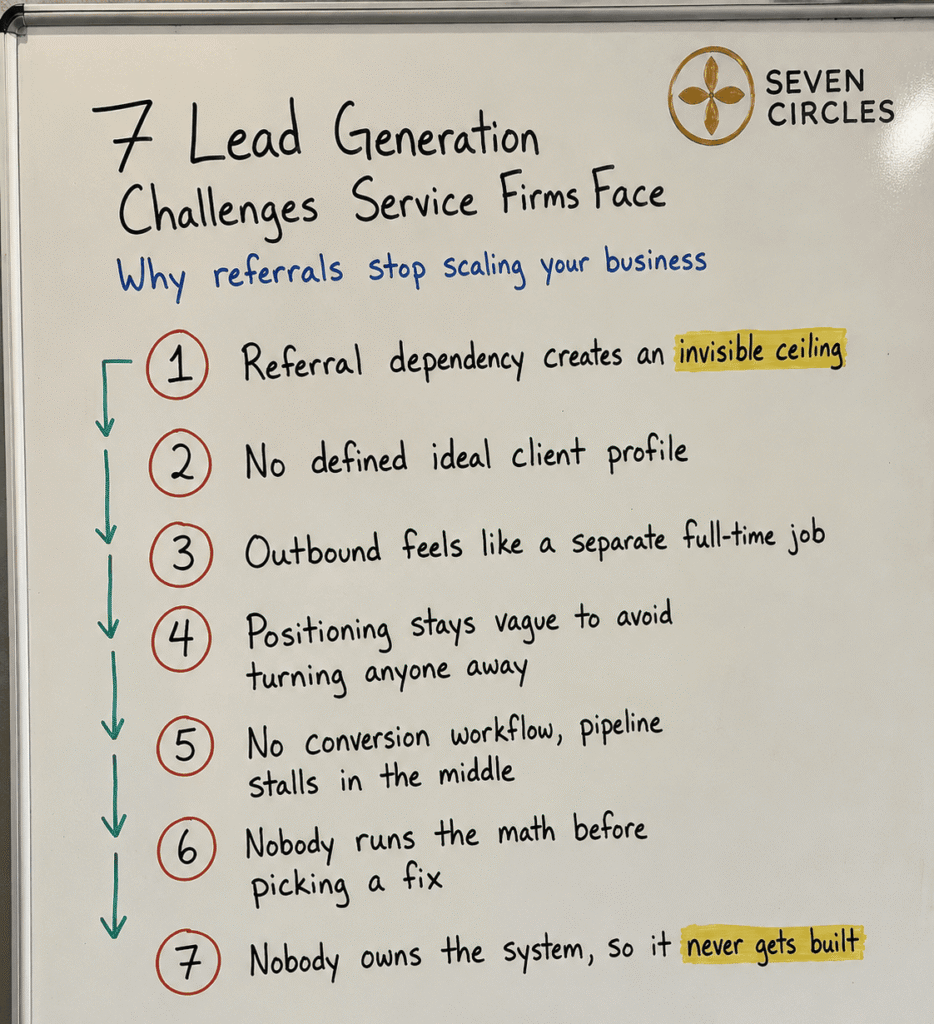
Below are the 7 specific service business lead generation challenges that show up over and over, and the mechanic behind each one.
Challenge 1: Referral Dependency Creates an Invisible Ceiling
Referrals feel free because no one bills you for them. They are not free. They cost you predictability.
A referral pipeline depends on other people remembering you exist during a month when they are busy running their own business. When that memory lapses, so does your pipeline. You cannot forecast a referral. You cannot schedule one. You can only wait for one.
This is the single biggest driver behind service business lead generation challenges: the business has a sales history but no sales process. Revenue happened, but nobody installed the mechanism that makes it happen again.
The fix: Keep asking satisfied clients for referrals, and set aside time each week to contact a defined list of companies that fit your ideal client profile. Track new conversations from each source separately so you can see whether your pipeline depends too heavily on referrals.
Challenge 2: No Defined Ideal Client Profile Means Every Lead Looks the Same
Without a written ideal client profile, every inbound inquiry gets treated as equally promising. Some of them are not. A service firm without a defined ICP spends the same hours qualifying a bad-fit lead as a great one, because there is no filter deciding which conversations deserve the time.
The fix is not more leads. It is a specific enough profile that your team can say no to the wrong ones fast, so the yes conversations get full attention.
The fix: Write down the industries, company sizes, buyer roles, and problems shared by your best clients. Use that profile to qualify each new lead.
Challenge 3: Outbound Feels Like a Separate Full-Time Job
Founders who try outbound prospecting for service firms usually try it the way they would a side project: an hour here, a batch of emails there, no calendar block, no consistency. Outbound only produces pipeline when it runs on a schedule long enough for the math to work. A few weeks of effort followed by three months of silence produces nothing, because prospecting has lag between first touch and closed deal.
Sales prospecting works like a system: frequent, honest, personalized touches sustained over a runway long enough for the lag to clear. Most service firms quit before that runway completes, then conclude outbound does not work for their industry, when what actually failed was the schedule.
The channel debate adds confusion on top of this. Founders ask whether LinkedIn or cold email is the answer, when the real question is which channel fits their industry and buyer, a question this comparison of LinkedIn versus cold email for B2B breaks down in more detail.
The fix: Assign someone to prospecting, block time for it each week, and track contacts, replies, and qualified conversations.
Challenge 4: Positioning Gets Vague to Avoid Turning Anyone Away
Service businesses often widen their positioning statement to avoid excluding potential clients. The result is a pitch that describes ten different services to ten different people, which reads as generic to all of them. A prospect scanning your site in six seconds needs to see themselves specifically, not broadly.
Vague positioning is not a copywriting problem. It is a decision problem: the founder has not decided who the business is for and who it is not for.
The fix: Choose one buyer group and one problem you solve well. Put both in the first sentence of your website and outreach.
Challenge 5: Pipeline Consistency Breaks Without a Conversion Workflow
A lead coming in is not the same as a lead moving forward. Service businesses often have a way to generate interest but no defined conversion workflow: what happens between first contact and signed contract, who owns each step, and what triggers the next one.
Without that workflow, deals stall in an undefined middle. Founders describe this as “everyone’s busy,” but the actual cause is usually a missing owner for the follow-up step. Sales pipeline management exists specifically to close that gap, and a sales pipeline shows you exactly where each prospect is in the process, which is the visibility most service firms lack entirely.
The fix: Define each pipeline stage, its owner, and the next action required before a deal can move forward.
Challenge 6: The Math Never Gets Run Before the Fix Gets Picked
Before installing any fix for these service business lead generation challenges, run the numbers. Revenue, average contract value, lifetime value, gross margin, lifetime gross profit, customer acquisition cost, growth goal, and capacity all interact. Lifetime gross profit divided by customer acquisition cost tells you whether a structured outbound motion is worth the investment. Capacity tells you whether the business can handle the volume a working system would generate.
A firm with high ACV and strong margins can absorb a real client acquisition system fast. A firm with thin margins needs to fix pricing before fixing lead generation, or the new pipeline just produces more low-profit work. HubSpot’s breakdown of sales pipeline management is a reasonable starting map for structuring that workflow.
The fix: Calculate the gross profit from an average client and compare it with your cost to acquire one before increasing outreach spend.
Challenge 7: Nobody Owns the System, So It Never Gets Built
Every challenge above gets identified in a sales meeting at some point. Almost none of them get fixed, because fixing them is not anyone’s job. The founder is busy delivering client work. There is no ops hire dedicated to installing a repeatable motion. The gap sits there, named but unowned, until the next slow month makes it painful again.
The fix: Name one person responsible for reviewing lead generation results weekly and making sure agreed actions happen.
What Actually Solves These Challenges
None of these service business lead generation challenges resolve with more hustle from the founder. They resolve with a system: a defined ideal client profile, a repeatable outbound motion, a conversion workflow with clear ownership, and positioning specific enough to filter fast.
A revenue system installation replaces the founder as the engine and installs the engine itself. The founder still runs the business. The business stops running only on the founder’s referral network.
Next Step
If you want to see where your own service business stands against these challenges, a Revenue Assessment gives you a specific diagnosis instead of a general one.