
You have been told to pick one. An agency told you cold email is dead. A LinkedIn guru told you email goes to spam. Both of them are selling the channel they happen to run.
The LinkedIn vs cold email B2B debate has a real answer, and it does not start with the channel. It starts with who you sell to, how many of them exist, and how fast you need to reach them. Pick the channel first and you will spend six months learning that your market was never on the platform you chose.
Here is the decision frame, the mechanics of each channel, and the case for running both.
Which Is Better for B2B Service Firms: LinkedIn or Cold Email?
LinkedIn is often useful when you sell to a small group of buyers who actively use the platform and each deal needs a personal approach. Cold email can help you reach a larger, well-researched list. Test both against qualified replies and booked meetings before choosing where to spend more time.
What LinkedIn vs Cold Email B2B Outreach Actually Means
Cold email is a volume channel with weak targeting precision and strong reach. You can contact 2,000 people this month if your infrastructure holds. You cannot verify that any of them are the right person beyond what your data provider claims.
LinkedIn is a precision channel with hard volume ceilings. You can see the person’s title, tenure, headcount, recent posts, and mutual connections before you send a single word. You also cannot send more than roughly 20 to 30 connection requests a day without risking restriction.
That trade is the whole decision. Reach versus precision. Everything else is execution detail.
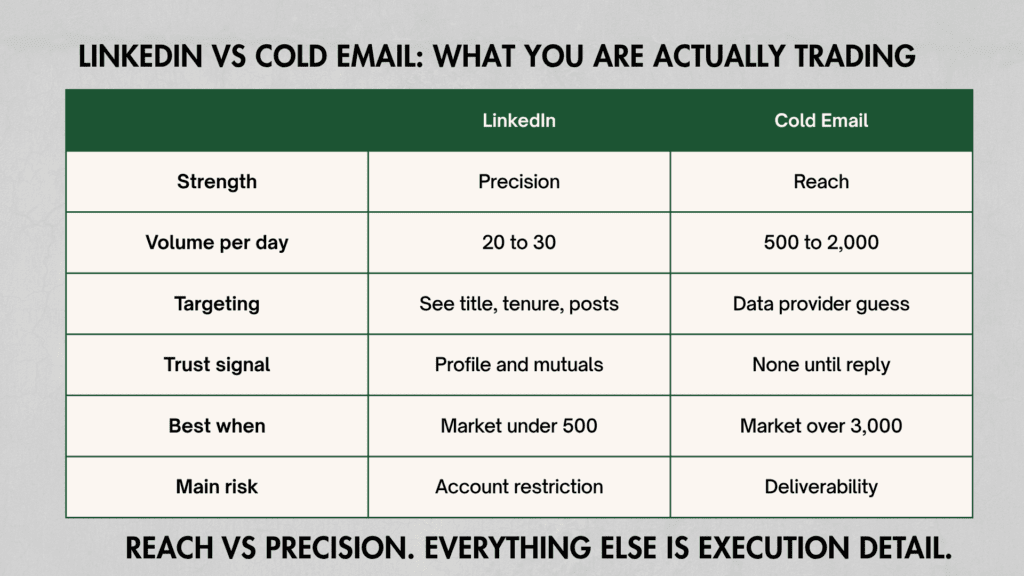
When Cold Email Wins the LinkedIn vs Cold Email B2B Argument
Cold email is the right primary channel when your total addressable market is large and your average contract value is moderate.
If there are 8,000 companies that fit your ideal client profile in the United States, you cannot personally research 8,000 people. You need a channel that lets volume do the work while your message does the qualifying. Email is that channel.
Email also wins when your buyer is not a LinkedIn native. Owners of HVAC contractors, manufacturing plants, logistics firms, and family-run professional services often have a dormant LinkedIn profile and a very active inbox. Sending them a connection request is sending mail to an address nobody checks.
The catch is infrastructure. Cold outreach for service firms fails on deliverability far more often than it fails on copy. Separate sending domain, warmed inboxes, SPF and DKIM and DMARC configured, sending volume capped per inbox. Skip that and your open rate problem is not a writing problem.
When LinkedIn Wins
LinkedIn is the right primary channel when your market is small, your ACV is high, and your buyer lives on the platform.
If there are 300 companies you could realistically serve, precision beats volume every time. You can read what the founder posted last week, see that they just hired their third engineer, and reference something specific that no automated sequence could produce. That level of relevance is worth more than 500 additional sends.
LinkedIn also wins when trust is the bottleneck. A profile with a real face, real posts, and mutual connections carries proof that a cold email address does not. For high consideration services where the buyer is handing you access to their revenue or their systems, that proof shortens the path.
The ceiling is real though. Connection limits, InMail credits, and message caps mean LinkedIn will never be your volume engine. Treat it as a scalpel.
LinkedIn vs Cold Email B2B: The Ultimate 4-Step Test
Run the arithmetic before you run the campaign. Four inputs decide it.
Market size. Count the companies that genuinely fit your ideal client profile. A smaller market may justify more individual research on LinkedIn; a larger market may make email easier to scale. Use your buyers’ actual activity and campaign results to decide.
Average contract value. Higher ACV justifies more time per prospect, which favors LinkedIn. Lower ACV needs volume, which favors email.
LTGP divided by CAC. Lifetime gross profit against customer acquisition cost tells you how much you can afford to spend acquiring a client. If that ratio is tight, the cheaper channel per contact wins, and that is usually email. If the ratio is generous, precision pays for itself.
Capacity. Count how many new clients you could onboard next quarter without service quality dropping. A channel that produces more meetings than you can serve is not a win, it is a liability. Sales forecasting discipline applies to outbound the same way it applies to a closing pipeline.
Most founders skip this and pick based on which article they read last. The four numbers above take an afternoon and remove the guessing entirely.
Why Running Both Beats Picking One
The framing of LinkedIn vs cold email B2B outreach assumes the two channels compete. In practice they compound.
A prospect who sees a connection request, then receives an email two days later, then sees your name on a post the following week has encountered you three times. Three touches across two channels reads as presence. Three emails in the same week reads as pressure.
The sequencing that works for most B2B service firms looks like this.
LinkedIn connection request with no pitch. Email touch referencing something specific and observable. LinkedIn follow up only if the email went unanswered. No channel carries the full load, and no single channel gets burned out.
This is also why structured prospecting beats channel loyalty. The prospect does not care which platform you used. They care whether the first thing you said was relevant.
What Breaks in Both Channels
Before you argue LinkedIn vs cold email B2B strategy any further, know that the failure modes are nearly identical and neither is about the channel. Most of them trace back to the same revenue leaks that quietly drain B2B firms.
No ideal client profile. Sending to a list that is 40 percent wrong makes both channels look broken. Fix targeting before you touch copy.
Pitching on first touch. Asking for a call before you have earned attention kills reply rates on LinkedIn and email equally. Lead with an observation about their business, not a description of yours.
No tracking. If you cannot say how many sends produced how many replies produced how many meetings, you cannot improve anything. Both channels need the same pipeline stage discipline as your inbound.
Inconsistency. Six weeks on, four weeks off, restart from zero. Outbound compounds only when it runs continuously. This is the single most common reason founders conclude a channel does not work.
What to Do This Week
The LinkedIn vs cold email B2B debate is a distraction from the harder question, which is whether you have a repeatable outbound motion at all. Most referral-dependent firms do not, and adding a channel to a system that does not exist yields nothing.
Start with the four numbers: market size, ACV, LTGP against CAC, and capacity. They will tell you which channel to lead with, and whether you can afford to run both. Then build the targeting and the messaging before you build the sending infrastructure.
If you want a read on where your client acquisition currently breaks, start with the seven places revenue usually leaks out of a B2B firm. Fix those before you add a channel on top of them.
Unsure which channel fits your buyers? See how Seven Circles builds a targeted outreach process.