
Revenue leaks rarely announce themselves. Most founders can name their revenue number. Almost none can name where it goes missing.
The leaks are never dramatic. Nobody loses a year of growth in one bad quarter. It happens in the deal that never got a second follow-up, the prospect who was never a fit in the first place, the month the referrals went quiet and nothing replaced them. Each one looks small on the day it happens. Stacked across four quarters, they are the difference between the business you run and the business you thought you were building.
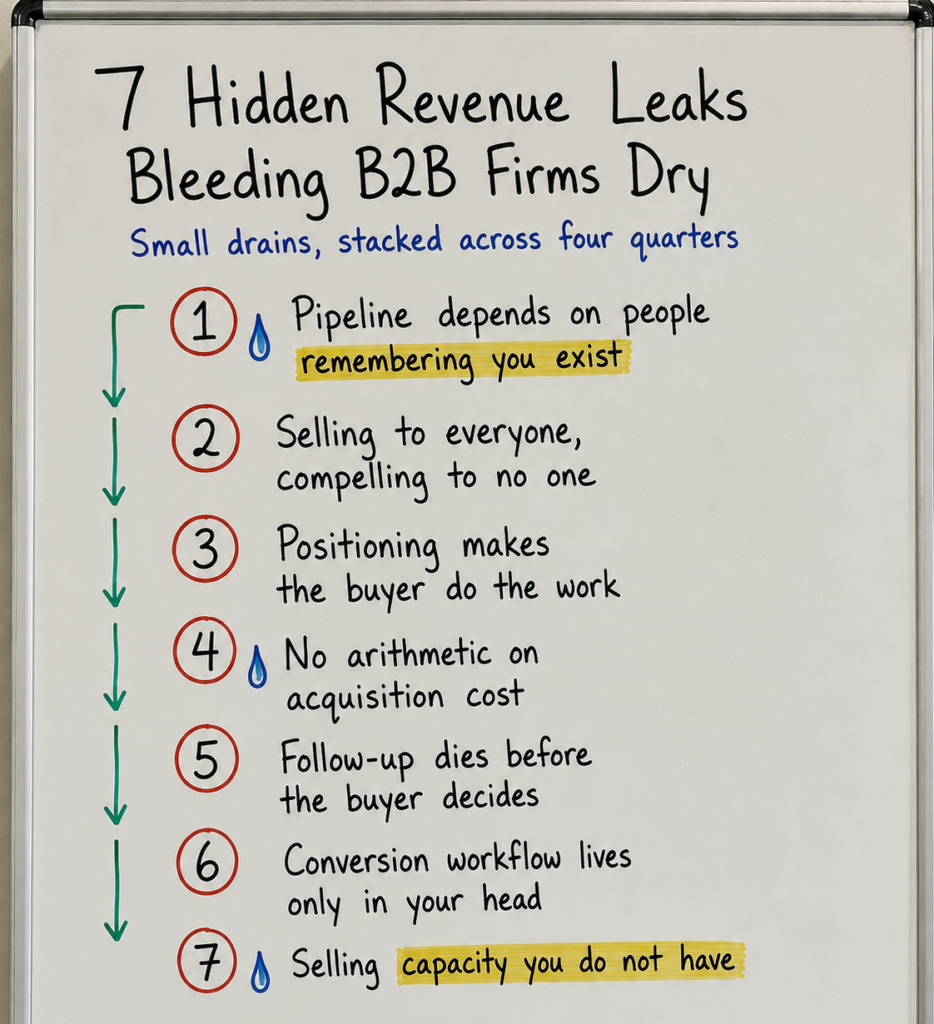
A working revenue system exists to close revenue leaks on purpose instead of hoping the good months cover the bad ones. Below are the seven that show up most often in referral-dependent service firms, the mechanic behind each one, and what closing it actually requires.
Quick check: Are referrals your only source of new clients? Are poor-fit prospects taking up sales time? Do deals go quiet after the first conversation? These are signs to examine your targeting, follow-up, and sales process. The seven checks below show where to look first.
Revenue leak 1: Your pipeline depends on other people remembering you exist
Referrals are not a strategy. Referrals are a result you do not control.
The mechanic is simple. A referral arrives when someone who liked your work happens to be in a conversation with someone who needs your work, during a week when they remember to say your name. Three coincidences have to line up. You control none of them. That is why referral revenue feels random even when the quality is high: it is random.
Referral dependency also hides its own cost, which is what makes it the hardest of the revenue leaks to see from the inside. The good months feel like proof the model works. The quiet months feel like bad luck rather than a structural gap. So nothing gets built, and the next quiet month arrives the same way the last one did.
The fix is not “get more referrals.” The fix is a second source of pipeline that runs whether or not anyone thinks of you, which is the entire point of installing outbound as revenue infrastructure rather than treating it as a campaign you run when things get slow.
Revenue leak 2: You are selling to everyone, so you are compelling to no one
Without a written ideal client profile, every inbound conversation looks like an opportunity. That feels like abundance. It is actually the most expensive of the seven revenue leaks.
Here is the mechanic. A prospect outside your profile takes the same discovery call, the same proposal, and the same follow-up as a prospect inside it, but converts at a fraction of the rate, and if they do buy, they cost more to deliver and churn faster. You pay full acquisition cost for a worse outcome. Do that across a year and your sales capacity is consumed by the accounts you should have declined. Few revenue leaks cost this much this quietly.
A real profile is not “small businesses in the Northeast.” It is specific enough to disqualify. Company size, industry, current acquisition method, the trigger that makes the problem urgent, and the reason they would choose you over doing nothing. If your profile cannot tell you who to say no to, it is a description, not a filter.
Revenue leak 3: Your positioning makes the buyer do the work
Most service firms describe what they do. Buyers need to know what changes.
“Full-service marketing support for growing companies” tells a founder nothing about their own situation. They have to translate it, and translation costs energy that they will not spend on a stranger. So the message lands as noise and the meeting never happens.
Positioning that works names the reader’s situation before it names your service. It says who this is for, what specific state they are in, and what the after state looks like. It is also the highest-leverage item on this page, because positioning multiplies every other channel you run. Weak positioning does not fail loudly. It just makes every other leak worse, which is why revenue leaks downstream of it never stay fixed.
Revenue leak 4: You are not doing the arithmetic on acquisition cost
Ask most founders what a client costs to acquire and you get a shrug or a guess. That shrug is where the money goes, and it feeds most of the revenue leaks below it.
Eight numbers tell you whether your growth motion is worth running: revenue, average contract value, lifetime value, gross margin, lifetime gross profit, customer acquisition cost, growth goal, and capacity. The two that matter most sit in a ratio. Lifetime gross profit divided by CAC tells you what each dollar of acquisition returns. If that ratio is healthy, spending more is not a risk, it is the obvious move. If it is thin, no amount of outbound volume saves you, and adding volume just loses money faster.
The reason this matters is not reporting. It is decision speed. Founders who know the ratio can commit to a channel in a week. Founders who do not will pilot something for six months, get an ambiguous result, and quietly stop. That hesitation is one of the revenue leaks with no line item, which is exactly why it survives so long. Gong’s research on forecasting makes a related point about pipeline math: a number you cannot defend is a number you will not act on.
Revenue leak 5: The follow-up dies before the buyer decides
Interest is not intent, and intent is not timing. A prospect can want what you sell and still be four months away from buying it.
The mechanic is a mismatch between your patience and their calendar. You send one message, maybe two. They were mid-quarter, mid-hire, mid-something. A missing reply does not always mean the buyer has rejected you; the timing or message may be wrong. Follow up with relevant information, and respect a clear no. Of all the revenue leaks here, this is the one you have already paid for. But without a defined cadence, no reply gets filed as a dead lead, and the pipeline you already paid to build gets thrown out at the exact moment it was starting to work.
A cadence fixes this by removing the judgment call. Sequence length, touch spacing, channel mix, and what happens at the end are decided once and then executed, so nobody has to feel out whether a fifth message is too many. HubSpot’s prospecting guide is a reasonable place to see how the spacing logic works in practice.
Revenue leak 6: Your conversion workflow lives in your head
Two founders run the same discovery call and get different outcomes. Same offer, same price, same prospect type. The difference is that one of them asked the question that surfaced the real constraint and the other one talked about their process.
When the workflow is undocumented, quality is a function of your energy on the day. That is survivable while you are the only person selling. It becomes the ceiling the moment you try to add anyone else, because there is nothing to hand them. You cannot delegate a process that exists only as instinct.
Documented does not mean scripted. It means the stages are defined, the qualification criteria are written, the exit condition for each stage is explicit, and the deal either advances or it does not. HubSpot’s breakdown of pipeline management covers the mechanics of stage discipline if you are starting from a blank page.
Revenue leak 7: You sell capacity you do not have
The last one punishes success.
Outbound works. Meetings land. Three clients sign in the same month. Then delivery buckles, quality slips, the founder disappears into the work, and prospecting stops entirely. Ninety days later the pipeline is empty because nobody fed it, and the cycle restarts from zero.
Capacity is one of the eight numbers for a reason. It tells you what your client acquisition system is allowed to produce before it starts damaging the business. Growth that outruns delivery is not growth, it is a churn event with a delay on it. Revenue leaks on the delivery side end careers faster than the ones on the sales side. The sequencing matters: figure out what you can deliver, then build the motion that fills it, then expand both together.
Why patching one revenue leak at a time never moves the number
None of these seven revenue leaks are marketing problems. They are infrastructure problems, and they compound in both directions.
Fix positioning and outbound converts better. Fix the profile and CAC drops. Fix the cadence and the pipeline you already built starts producing. Fix capacity and the whole thing survives working. Revenue leaks feed each other, which is why the system has to be installed as a system.
Start by finding out which revenue leaks you have. Most founders can guess at two or three and are wrong about at least one, usually the arithmetic, because that is the part nobody checks. The Revenue Score assessment walks through all seven revenue leaks and tells you where your revenue is actually going before you spend another dollar trying to grow it.