
Most service businesses do not lose deals because their team lacks effort. They lose deals because the sales conversation is too generic, too rushed, or disconnected from the buyer’s real problem.
The best B2B sales examples show what effective selling looks like in actual situations: how to open a conversation, diagnose a business problem, explain value, follow up, and ask for a decision without creating unnecessary pressure.
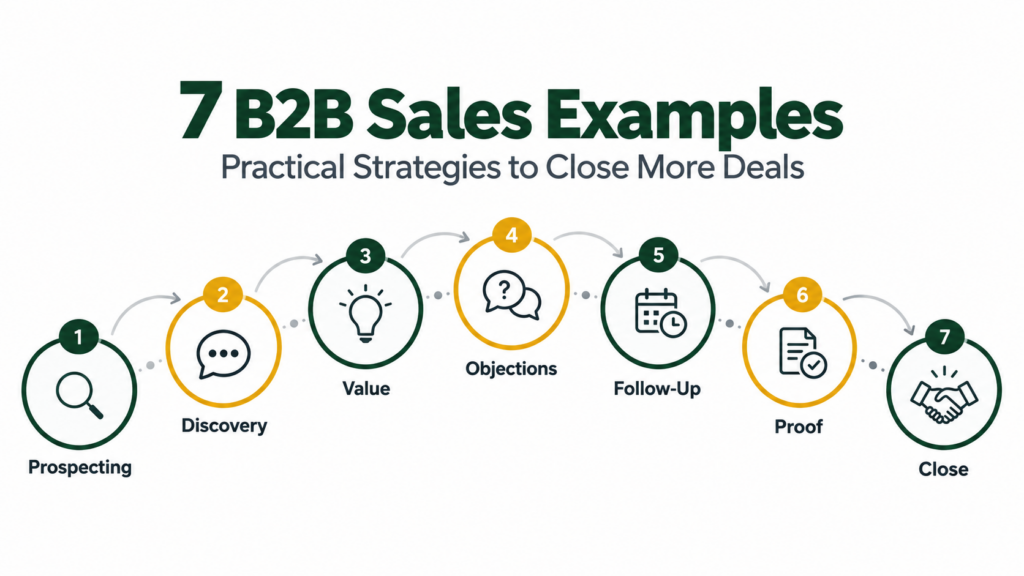
This guide breaks down seven practical examples that consulting firms, staffing companies, agencies, IT providers, engineering firms, and other B2B service businesses can adapt to their own sales process.
What Is an Example of a B2B Sale?
A B2B sale happens when one business sells a product or service to another business. For example, an IT provider sells managed support to a healthcare company, a staffing firm helps a manufacturer fill open roles, or a consulting firm helps a service company improve its sales process.
The seven examples below show how those businesses can prospect, run sales conversations, follow up, and close deals.
Table of Contents
- Trigger-based prospecting
- Problem-led discovery
- Value-based positioning
- Consultative objection handling
- Multi-channel follow-up
- Proof-based selling
- Decision-focused closing
What Makes B2B Sales Different?
B2B sales usually involve a larger financial commitment, more than one stakeholder, and a longer decision process than a typical consumer purchase. The buyer is rarely deciding based on personal preference alone. They are evaluating business risk, expected return, internal priorities, implementation effort, and whether your company can deliver.
That means strong B2B selling is not simply explaining what you offer. It is helping the buyer understand:
- What problem needs to be solved
- Why it matters now
- What the problem is costing the business
- What a better future state looks like
- Why your approach is credible
- What should happen next
A defined sales process helps keep those conversations consistent. Pipedrive’s overview of the B2B sales process similarly organizes selling around prospecting, research, outreach, and deal progression. The specific stages may vary, but buyers still need clarity before they can make a confident decision.
If your company needs a clearer structure from first contact through close, review the Seven Circles guide to the B2B sales process.
1. Trigger-Based Prospecting
The first of these B2B sales examples begins before the sales call. Instead of contacting every company that matches a broad industry or employee range, the seller looks for evidence that a company may need help now.
Example
An IT services firm notices that a regional healthcare company recently opened a second location and is hiring 25 new employees. Rather than sending a generic message about managed IT services, the seller connects the expansion to a likely operational challenge.
Sample outreach:
Hi Marcus, I saw that your team is opening a second location and expanding headcount. Growth at that stage often creates gaps in user onboarding, access management, and IT support coverage. How is your team preparing the infrastructure for the additional employees?
This message works because it starts with a visible business event. It does not assume the prospect has a problem, and it does not force an immediate meeting request. It opens a relevant conversation.
How to apply it
Look for triggers such as:
- New locations
- Rapid hiring
- Recent funding
- Leadership changes
- New service launches
- Regulatory changes
- Multiple open roles
- Technology migrations
Trigger-based prospecting improves relevance because the message is connected to something happening inside the prospect’s business.
2. Problem-Led Discovery
Weak discovery calls become presentations too quickly. The seller hears one problem, decides what the prospect needs, and starts explaining the solution. Strong discovery slows the conversation down long enough to understand the cause, impact, urgency, and desired outcome.
Example
A staffing company says it needs more clients. Instead of immediately offering lead generation, the seller asks:
- How are new opportunities entering the pipeline today?
- Which industries and roles produce the strongest margins?
- Where do deals usually stall?
- How many conversations are required to create one qualified opportunity?
- What happens when referrals slow down?
- What revenue target is the current process failing to support?
The discussion reveals that the company does not actually have a lead-volume problem. It has poor targeting, inconsistent follow-up, and no clear qualification criteria.
Among the B2B sales examples in this guide, this one matters because better questions can completely change the solution a buyer actually needs.
Why it works
Problem-led discovery prevents the seller from recommending the wrong solution. It also helps the buyer see the full business impact of an issue they may have treated as a surface-level symptom.
The objective is diagnosis, not interrogation. Ask one question at a time, listen carefully, and use the buyer’s answers to guide the next question.
3. Value-Based Positioning
Buyers do not purchase a list of activities. They purchase an improved business outcome. Value-based positioning connects your service to the result the buyer is trying to achieve.
Example
An agency could describe its service like this:
We write emails, build prospect lists, set up automations, and manage your CRM.
That explains the work, but it does not explain why the work matters.
A stronger version would be:
We build the prospecting, follow-up, and CRM system your team needs to create more qualified sales conversations without relying only on referrals.
The second statement gives the activities a business purpose. It makes the offer easier to understand and easier to evaluate.
How to apply it
Connect each deliverable to a practical outcome:
- CRM setup → clearer pipeline visibility
- Automated follow-up → fewer qualified leads going cold
- Ideal-client-profile development → better targeting and less wasted outreach
- Sales messaging → more relevant buyer conversations
- Reporting → faster decisions about what to improve
Seven Circles helps service businesses connect these pieces through its B2B sales and growth services.
4. Consultative Objection Handling
An objection is not always a rejection. It may mean the buyer lacks information, sees too much risk, has another priority, or does not yet understand the value.
Example
The buyer says:
We need to think about it.
A defensive seller starts repeating benefits or offering a discount. A consultative seller responds:
That makes sense. When you say you need to think about it, is the main question the timing, the investment, the approach, or something else?
This response is calm and specific. It gives the buyer room to explain the real concern.
If the issue is timing, the seller can explore urgency. If the issue is investment, the conversation can return to financial impact. If the buyer is unsure about delivery, the seller can explain the implementation process or provide relevant proof.
Why it works
Good objection handling does not overpower resistance. It identifies the missing information behind it. The seller’s job is to create clarity, not pressure.
5. Multi-Channel Follow-Up
Many qualified opportunities disappear because follow-up is irregular. One email is sent after the meeting, another is sent two weeks later, and then the opportunity is forgotten.
Example
A consulting firm follows a simple sequence after a positive discovery call:
- Day 0: Send the recap, agreed priorities, and next step
- Day 2: Share a relevant framework or short case example
- Day 5: Connect on LinkedIn with a personal note
- Day 9: Ask whether the initiative is still a priority
- Day 14: Send a brief close-the-loop message
Each touch has a reason. The sequence does not repeat “just checking in.” It adds context, answers likely questions, or moves the decision forward.
This is one of the most practical B2B sales examples for service firms because consistent follow-up can recover opportunities that would otherwise go cold.
Email and LinkedIn can support each other when they are used intentionally. Our guide on LinkedIn vs. cold email for B2B service firms explains when each channel is most useful and why a coordinated approach often works better than choosing only one.
6. Proof-Based Selling
Claims are easy to make. Proof reduces the buyer’s perceived risk.
Example
Instead of saying:
Our process improves sales performance.
Say:
A client came to us with leads spread across spreadsheets, inconsistent follow-up, and no clear pipeline stages. We centralized the process, defined ownership, and installed follow-up workflows. Within the first 60 days, leadership could see every active opportunity, the next action, and where deals were stalling.
This example is more credible because it includes the starting condition, the intervention, and the operational result. If you have verified numbers, add them. If you do not, never invent statistics. Specific qualitative evidence is better than unsupported quantitative claims.
Useful proof can include:
- Case studies
- Client testimonials
- Before-and-after process maps
- Sample dashboards
- Demonstrations
- Relevant experience
- Documented implementation plans
HubSpot’s overview of sales enablement includes case studies, demo decks, whitepapers, and competitive information among the content sellers can organize and use during the sales process.
7. Decision-Focused Closing
Closing should not feel like a sudden shift from helpful conversation to pressure. A strong close confirms what has already been established and makes the next decision clear.
Example
Based on what you shared, the main priorities are improving targeting, creating consistent follow-up, and giving leadership better pipeline visibility. Our 90-day implementation is designed to address those three areas. Is there anything you still need to feel comfortable moving forward?
If the buyer says no, the seller can ask:
Would you like to begin with the standard implementation timeline, or do you need an accelerated start?
This close works because it summarizes the buyer’s priorities before asking for commitment. It also surfaces unresolved concerns instead of pretending they do not exist.
A simple closing rule
Do not ask for commitment until you have confirmed:
- The problem
- The business impact
- The desired outcome
- The decision process
- The recommended solution
- The next step
How to Use These B2B Sales Examples in Your Business
Do not copy every script word for word. Adapt the principles to your market, offer, and buyer.
Start with one part of the sales process:
- Review five recent opportunities.
- Identify where each opportunity slowed down or was lost.
- Choose the example that addresses that stage.
- Create one repeatable script, template, or checklist.
- Test it for 30 days.
- Track conversations, meetings, qualified opportunities, proposals, and wins.
- Improve the process using actual results.
The purpose of these B2B sales examples is not to give your team rigid scripts. Use them as starting points, then improve the language based on real buyer responses.
LinkedIn’s collection of B2B sales resources also emphasizes areas such as research, stakeholder engagement, trust, and multithreading. Those ideas reinforce a central point: effective B2B selling is a coordinated process, not one clever closing line.
Common Mistakes to Avoid
Even good B2B sales techniques fail when the underlying process is weak. Avoid these common mistakes:
Reviewing B2B sales examples is useful only when the lessons are translated into a consistent process your team can execute and measure.
Pitching before diagnosing
Do not prescribe a solution before you understand the problem. Early pitching makes the conversation about your company instead of the buyer.
Targeting everyone
A broad list may create activity, but it rarely creates enough qualified conversations. Define the companies, roles, and business signals that matter.
Following up without value
“Just checking in” gives the buyer no new reason to respond. Add insight, proof, clarification, or a decision point.
Discounting too early
Price is not always the real objection. Clarify the concern before reducing the investment or removing important scope.
Failing to track the pipeline
If you cannot see how many opportunities enter each stage, where they stall, and why they are lost, improvement becomes guesswork.
Final Takeaway
The strongest B2B sales examples are not aggressive. They are relevant, structured, and focused on helping the buyer make a sound business decision.
Use triggers to make outreach timely. Diagnose before recommending. Connect your service to business value. Treat objections as requests for clarity. Follow up with purpose. Use proof to reduce risk. Close by confirming the buyer’s priorities and establishing the next step.
When these actions operate as one system, your sales process becomes easier to manage, measure, and improve.
The best B2B sales examples ultimately share the same foundation: relevance, disciplined discovery, clear value, credible proof, and a defined next step.
If your company has outreach activity but lacks a consistent process for turning conversations into qualified opportunities, explore Seven Circles services or contact the team to discuss where your current sales system may be breaking down.
Frequently Asked Questions
What are B2B sales examples?
B2B sales examples are practical situations that show how one business prospects, communicates value, handles objections, follows up, and closes a sale with another business.
What is an example of a B2B sale?
An IT provider selling managed support to a healthcare company is one example. Other examples include a staffing firm selling recruitment services, a consultant delivering strategic advice, or an agency managing marketing for another company.
What are the most effective B2B sales techniques?
Effective techniques include trigger-based prospecting, problem-led discovery, value-based positioning, consultative objection handling, consistent follow-up, proof-based selling, and decision-focused closing.
How is B2B sales different from B2C sales?
B2B sales commonly involve higher contract values, multiple decision-makers, longer evaluation periods, and more attention to risk, return, implementation, and business impact.
How can a service business improve its B2B sales process?
Start by defining the ideal client, mapping the sales stages, standardizing discovery and follow-up, tracking conversion at each stage, and reviewing why opportunities are won or lost.