
Most B2B service businesses do not lose deals because their team is not working hard enough.
They lose deals because there is no clear process between the first conversation and the final decision.
A prospect replies to an email. A meeting gets booked. The call goes well. A proposal is sent.
Then the deal goes quiet.
The team is unsure who owns the follow-up, what the next step should be, whether the opportunity is truly qualified, or why the prospect stopped responding. That is not simply a sales problem. It is a process problem.
Clear B2B sales process stages help B2B service firms move from random activity to a structured way of finding, qualifying, and converting the right opportunities.
These B2B sales process stages give service businesses a practical framework for turning sales activity into qualified opportunities.
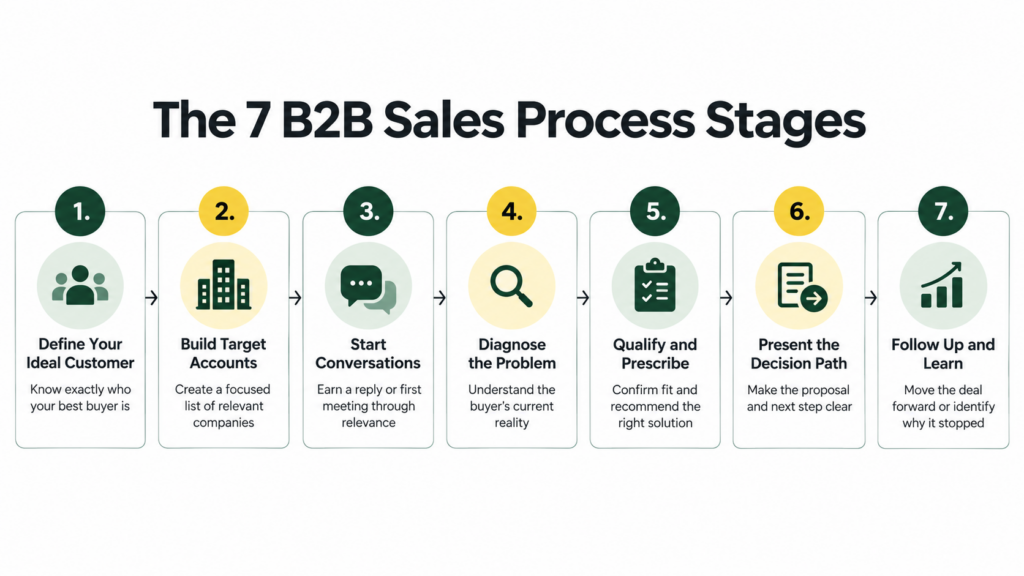
The 7 B2B Sales Process Stages at a Glance
- Define your ideal customer profile
- Build a targeted account list
- Start relevant conversations
- Diagnose the buyer’s problem
- Qualify the opportunity and recommend a solution
- Present a clear decision path
- Follow up, close, and learn
What Are B2B Sales Process Stages?
B2B sales process stages are the defined steps a business uses to move a potential buyer from first contact to a signed agreement and successful onboarding.
A strong sales process gives every opportunity a clear path. Instead of relying on memory, individual selling styles, or last-minute follow-up, the team knows what needs to happen at each point in the buyer journey.
The goal is not to make sales feel robotic.
The goal is to make sure the right prospects receive the right conversation, information, and follow-up at the right time.
A sales process should help you answer questions such as:
- Who is a good fit for our business?
- What problem are they trying to solve?
- What qualifies someone as a real opportunity?
- When should we send a proposal?
- How should we follow up after a proposal?
- Why are good opportunities not becoming clients?
For a broader view of how a structured sales process works, Salesforce has a helpful guide on how to build a sales process.
1. Define Your Ideal Customer Profile
The first of the B2B sales process stages is deciding who belongs in your pipeline.
Many service firms make the mistake of saying they work with “small businesses,” “growing companies,” or “anyone who needs help.” That language sounds flexible, but it makes selling harder.
When you try to speak to everyone, your message becomes too broad to feel relevant to anyone.
Your ideal customer profile should define:
- The industries you serve
- Company size
- Revenue range
- Typical decision-maker
- Problems they are already experiencing
- Signals that they may need help now
- Whether they can realistically benefit from and invest in your service
For example, a B2B consulting firm may be best positioned to work with founder-led service companies that have strong delivery but inconsistent new-business activity. The founder may still be responsible for sales, referrals may be doing most of the work, and there may be no defined process for prospecting or follow-up.
That is a much stronger target than simply “businesses that need growth.”
A clear ICP improves your list building, messaging, discovery calls, and close rate because your team is spending time with companies that are more likely to be a genuine fit.
2. Build a Targeted Account List
The next B2B sales process stages focus on account selection and starting relevant conversations.
Once you know who you want to serve, build a list of companies that match that profile.
This stage is not about collecting the largest possible database. It is about finding the most relevant accounts.
A list of 250 companies that fit your offer is more valuable than 10,000 contacts with no real reason to care about what you do.
Look for signals that a company may be experiencing a problem you can solve:
- They are hiring sales, business development, or marketing roles
- They are expanding into new markets
- They are launching a new service
- They have recently grown their team
- Their founder is visibly responsible for sales
- Their business appears to rely heavily on referrals
- They are posting growth content but have no visible outbound process
- They have a sales team but no clear CRM, follow-up, or reporting structure
Then identify the people who are most likely to care about the issue. For a B2B service offer, that might be the founder, CEO, COO, VP of Sales, or Head of Growth.
The goal is not to contact every person at the company. It is to start with the person most connected to the business outcome you help create.
If your team needs help building targeted account lists, tightening outreach, and creating stronger pipeline activity, explore Seven Circles’ Lead Generation Specialist service.
3. Start Relevant Conversations
The third stage is outreach.
Most cold outreach fails because it begins with a pitch before the prospect has a reason to care.
A prospect does not wake up thinking:
“I need a new sales process consultant.”
They may be thinking:
“Why is the founder still carrying all the sales activity?”
“Why do we have conversations but no consistent pipeline?”
“Why do proposals keep going quiet?”
“Why are we dependent on referrals again this quarter?”
Your first message should be built around a problem they may already recognize.
Instead of saying:
“We help businesses grow through sales and marketing solutions. Can we schedule a call?”
Try a question that shows relevance:
“As B2B service firms grow, we often see the founder remain responsible for sales while follow-up and pipeline visibility become inconsistent. Has your team already solved that?”
The purpose of the first message is not to explain every service you offer.
It is to earn the next conversation.
Use LinkedIn, email, referrals, events, partnerships, and calls, but make the message specific to the prospect’s likely situation. A relevant question will outperform a generic introduction almost every time.
For more ideas on building an outreach system, read How to Generate Leads for a B2B Business.
4. Diagnose Before You Prescribe
A positive reply or booked meeting is not the moment to launch into a presentation.
It is the moment to diagnose.
This is where many B2B service firms lose credibility. They offer a solution before they understand the actual problem. The prospect may say they need more leads, but the deeper issue could be weak positioning, poor qualification, inconsistent follow-up, or no visibility into where deals are stalling.
A strong discovery conversation should uncover:
- How the business generates opportunities today
- Where most new clients currently come from
- What happens when referrals slow down
- Who owns sales and follow-up
- What the current pipeline looks like
- Where opportunities tend to disappear
- What the leadership team wants to improve
- The cost of leaving the problem unresolved
Useful discovery questions include:
- “What is creating the most pressure around new business right now?”
- “Where do you feel opportunities are being lost?”
- “What does your team currently do after the first conversation?”
- “How are proposals tracked and followed up?”
- “If nothing changes in the next six months, what does that cost the business?”
- “What would a stronger sales process allow the team to do differently?”
The goal is to help the buyer clearly understand the gap between where they are today and where they need to be.
Do not rush past that gap. It is the reason the buyer will decide to act.
See our B2B sales examples for service businesses for practical discovery, follow-up, and closing examples.
5. Qualify the Opportunity and Prescribe the Right Solution
Not every interested prospect should receive a proposal.
The fifth of the B2B sales process stages is qualification. This protects your time, keeps your pipeline clean, and prevents you from chasing opportunities that were never likely to close.
Before moving forward, confirm that the opportunity has:
- A clear business problem
- A need that matches your offer
- A decision-maker involved
- A reason to solve the problem
- A realistic timeline
- The ability to invest
- Agreement on what success should look like
Qualification is not about forcing a prospect to fit your offer. It is about determining whether you can genuinely help.
Once the opportunity is qualified, present a recommendation tied directly to what you learned.
For example:
“You have the right service and enough market demand, but there is no clear follow-up system once leads enter the pipeline. Before increasing outreach volume, the priority should be building a structured CRM, a consistent follow-up workflow, and a scorecard that shows where opportunities are being lost.”
That recommendation sounds more credible because it is based on their business, not a generic package.
6. Present a Clear Decision Path
The final B2B sales process stages determine whether a qualified opportunity moves toward a clear decision or gets lost in follow-up.
A proposal should make the decision easier.
Too many proposals explain a company’s services but fail to explain what happens next. They list deliverables, pricing, and timelines, then end with “Let us know if you have questions.”
That leaves the buyer with work to do.
A strong proposal should clearly outline:
- The problem you identified together
- The impact of the problem
- The recommended solution
- The scope of work
- What will be delivered
- Timeline and milestones
- Investment
- Client responsibilities
- The decision and onboarding process
After sending the proposal, schedule a decision conversation.
Do not assume silence means the buyer is not interested. They may be comparing options, handling another priority, waiting on an internal stakeholder, or unclear about what they are being asked to decide.
The decision conversation gives both sides clarity.
You can ask:
- “Does this plan address the problem we discussed?”
- “What questions need to be answered before you can decide?”
- “Who else needs to be part of the decision?”
- “What would need to happen for us to move forward?”
This is not pushy. It is professional.
7. Follow Up, Close, and Learn
The final stage is disciplined follow-up.
A proposal is rarely the end of the sales process. It is often where the real decision-making begins.
Many good opportunities are lost because the seller follows up once, receives no response, and then moves on. But prospects are busy. Timing changes. Internal decisions take longer. A thoughtful follow-up can bring a valuable conversation back to life.
Follow up with a reason, not just “checking in.”
For example:
“When we spoke, you mentioned the team was losing visibility after proposals were sent. I wanted to see whether this is still a priority for the quarter or whether timing has changed.”
That is better than:
“Just following up on my last email.”
Every opportunity should eventually move to one of three places:
- Closed won
- Closed lost
- Nurture or follow up later
If a deal does not close, record the reason. Was it timing, budget, urgency, fit, competition, decision-maker access, or unclear value?
Those answers matter. They show you where the sales process needs improvement.
How to Measure Your B2B Sales Process
Once your process is defined, track the numbers at each stage.
You do not need a complicated dashboard to start. You need visibility into the conversion points that matter.
Track:
- Target accounts added
- Outreach sent
- Replies received
- Conversations started
- Meetings booked
- Qualified opportunities
- Proposals sent
- Proposals accepted
- Closed-won revenue
- Closed-lost reasons
- Time spent in each stage
These numbers allow you to identify the real issue.
If outreach is high but replies are low, review targeting and messaging.
If meetings are happening but few opportunities are qualified, review your ICP and discovery process.
If proposals are being sent but not accepted, review your diagnosis, proposal quality, decision process, and follow-up.
A sales process gives you a way to improve the system instead of simply asking the team to “work harder.”
Build a B2B Sales Process Your Team Can Follow
The strongest B2B sales process is not the most complicated one.
It is the one your team can follow every day.
When B2B sales process stages are clearly defined, the team can improve performance without relying on guesswork.
Start with these seven stages:
- Define your ideal customer profile
- Build a targeted account list
- Start relevant conversations
- Diagnose before you prescribe
- Qualify the opportunity and prescribe the right solution
- Present a clear decision path
- Follow up, close, and learn
When each stage is clear, your team can create more consistency, identify revenue leaks earlier, and give good opportunities the attention they deserve.
Seven Circles helps B2B service businesses build the positioning, prospecting, CRM workflows, follow-up systems, and scorecards that support this process.
If you want to identify where your sales process is breaking down, request a Revenue System Review.
Frequently Asked Questions
What are the B2B sales process stages?
The seven B2B sales process stages are defining an ideal customer profile, building a target-account list, starting relevant conversations, diagnosing needs, qualifying opportunities, presenting a proposal, and following up through the final decision.
Why does a B2B service business need a sales process?
A defined sales process helps a B2B service business create consistency in prospecting, follow-up, qualification, proposals, and reporting. It also makes it easier to see where opportunities are being lost.
What is the difference between a sales process and a sales pipeline?
A sales process is the set of actions your team takes to move an opportunity forward. A sales pipeline is the visual view of where each opportunity sits within those stages.
How can a small B2B service firm improve its sales process?
Start by defining the ideal customer, standardizing outreach and discovery, setting clear qualification rules, tracking proposals, and creating a consistent follow-up process.