
Running a staffing agency can be rewarding, but finding a steady stream of clients is often one of the biggest challenges. You might have a database full of qualified candidates, an experienced recruitment team, and the ability to fill positions quickly. Yet none of that guarantees a consistent flow of new business.
The real challenge isn’t always finding talent. It’s finding companies that need your services and convincing them that your agency is the right recruitment partner.
If you’re wondering how to get more clients for your staffing agency, the answer lies in combining targeted prospecting, relationship building, digital marketing, and a repeatable sales process.
Whether you operate a temporary staffing company, an executive search firm, or a specialized recruitment agency, the following strategies can help you attract new clients, build stronger partnerships, and create opportunities for long-term growth.
1. Identify Your Ideal Staffing Clients
Before investing time in cold calls, email campaigns, or advertising, you need to understand exactly which businesses are most likely to benefit from your services.
Trying to sell staffing solutions to every company rarely produces the best results. Instead, focus on businesses that regularly hire employees, struggle to fill specialized positions, or experience fluctuating workforce demands.
Start by defining your ideal client profile (ICP).
Consider factors such as industry, company size, location, hiring frequency, recruitment budget, and the types of positions companies need to fill.
For example, a healthcare staffing agency might target hospitals, clinics, and medical facilities. An IT recruitment agency could focus on technology companies, software development firms, and businesses undergoing digital transformation.
When you know who your ideal clients are, you can create more relevant marketing messages and spend less time pursuing businesses that are unlikely to buy.
Practical tip: Build a list of 50–100 companies that closely match your ideal client profile. Research their hiring activity and identify the people responsible for recruitment decisions.
To understand how to get more clients for your staffing agency, start by identifying businesses that regularly need recruitment support and building relationships with their hiring managers.
2. Choose a Profitable Staffing Niche
One of the most effective ways to differentiate your staffing agency is to specialize in a particular industry or job category.
Many businesses prefer working with recruiters who understand their industry, hiring challenges, and required skills.
For example, an agency specializing in cybersecurity recruitment can develop a stronger understanding of technical qualifications, candidate expectations, and hiring trends than a generalist agency covering dozens of unrelated roles.
Potential staffing niches include healthcare, information technology, engineering, logistics, manufacturing, finance, construction, and executive recruitment.
Specialization can help your agency build industry credibility, develop targeted candidate pipelines, and communicate a clearer value proposition.
You don’t necessarily need to serve only one industry forever. However, establishing a strong reputation in one niche can make it easier to attract clients before expanding into additional markets.
For example, Bryant Staffing Solutions provides specialized recruitment services across industries such as healthcare, technology, engineering, and finance, illustrating how staffing agencies can focus on specific talent markets.
3. Use LinkedIn to Find Staffing Clients
LinkedIn is a valuable platform for staffing agency business development because it allows recruiters to identify companies, research decision-makers, and build professional relationships.
Instead of sending generic connection requests to hundreds of people, focus on businesses that match your ideal client profile.
Look for professionals such as HR directors, talent acquisition managers, recruitment managers, operations managers, founders, and business owners.
Once you identify a potential client, review the company’s hiring activity and look for opportunities to offer assistance.
For example, if a company is advertising several technical positions, you could contact its hiring manager with a relevant message.
Example LinkedIn outreach message:
Hi Sarah, I noticed your team is hiring several software engineers. We specialize in helping technology companies connect with qualified technical talent. I’d be interested in learning about your hiring priorities and whether additional recruitment support would be useful.
Keep your outreach short, personalized, and focused on the client’s needs.
Avoid immediately pushing your services. Your first goal should be to start a meaningful conversation.
Staffing agencies can improve their outreach strategy by understanding the differences between LinkedIn and cold email for B2B lead generation.
If you’re exploring how to get more clients for your staffing agency, combining LinkedIn outreach, targeted email campaigns, and referral marketing can help you build a stronger sales pipeline.
4. Build a Consistent Cold Email Outreach Strategy
Cold emailing remains a useful method of generating staffing agency leads when messages are relevant, personalized, and sent in accordance with applicable marketing and privacy laws.
The biggest mistake many staffing agencies make is sending identical promotional emails to large lists of companies.
Decision-makers receive numerous sales messages. Generic emails offering recruitment services rarely stand out.
Instead, research each prospect and explain why your staffing agency may be able to help.
A strong cold email generally includes a relevant subject line, a personalized introduction, a specific hiring challenge, a brief explanation of your solution, and a simple call to action.
Example cold email:
Hi Sarah,
I noticed your company is expanding its operations and currently recruiting for several positions.
We help growing businesses find qualified candidates while reducing the time their internal teams spend sourcing and screening applicants.
I’d be interested in learning about your current hiring priorities and seeing whether our recruitment services could support your team.
Would you be open to a brief conversation next week?
Best regards,
[Your Name]
[Staffing Agency Name]
Keep your message focused on starting a conversation rather than closing a deal immediately.
Also, make sure your outreach respects local email marketing requirements, including consent and opt-out rules where applicable.
5. Optimize Your Staffing Agency Website for SEO
Your website should do more than describe your services. It should help potential clients discover your agency through search engines and encourage them to contact you.
Search engine optimization (SEO) can help your staffing agency appear when businesses search for recruitment solutions.
For example, potential clients might search for phrases such as:
-
staffing agency for manufacturing companies
-
IT recruitment services
-
temporary staffing solutions
-
healthcare staffing agency
-
how to hire qualified employees quickly
Create dedicated service pages targeting relevant industries, job categories, and locations.
Each page should clearly explain the staffing services you offer, the problems you solve, the types of positions you recruit for, and how businesses can contact your team.
Include clear calls to action such as Request Staffing Support, Schedule a Recruitment Consultation, or Hire Qualified Talent.
For international agencies, consider creating location-specific pages only where you genuinely provide services. Avoid publishing nearly identical pages for countries or cities you don’t actively serve.
SEO takes time, but a well-structured website can become a valuable source of inbound staffing leads.
6. Publish Helpful Blog Content That Attracts Employers
Content marketing can position your staffing agency as a knowledgeable recruitment partner.
Instead of publishing articles only about your company, create content that answers questions employers are already asking.
Useful blog topics include:
-
How to Reduce Employee Turnover
-
Temporary Staffing vs. Permanent Recruitment
-
How to Hire Skilled Workers in a Competitive Market
-
Common Recruitment Mistakes Businesses Make
-
How to Improve Your Hiring Process
-
Benefits of Outsourcing Recruitment
Each article should address a specific challenge and provide practical solutions.
For example, a manufacturing staffing agency could publish an article explaining how businesses can prepare for seasonal workforce demand.
At the end of the article, invite readers to contact your team for additional recruitment assistance.
Over time, helpful content can improve search visibility, build trust, and encourage employers to consider your agency when they need staffing support.
7. Ask Existing Clients for Referrals
Your current clients can be one of your most valuable sources of new business.
A company that has had a positive experience with your staffing services may be willing to recommend your agency to other business owners or hiring managers.
However, referrals don’t always happen automatically.
After successfully completing a recruitment project, ask whether the client knows another organization that might benefit from similar support.
You might say:
We’re glad we could help your team fill these positions. If you know another company facing similar hiring challenges, we’d appreciate an introduction.
Make the request natural and avoid pressuring clients.
You can also maintain relationships with former clients, placed candidates, industry contacts, and professional partners who may refer business opportunities.
A structured referral process can help you generate warm introductions without relying entirely on cold prospecting.
8. Use Google Business Profile for Local Visibility
Although your staffing agency may serve international clients, local search visibility can still be important.
Many businesses prefer working with recruitment partners that understand their local labor market.
If your agency is eligible, create or optimize your Google Business Profile.
Ensure your business name, address or service area, contact information, website, and business category are accurate.
Encourage satisfied clients to leave genuine reviews describing their experiences.
You can also publish relevant updates about your staffing services and keep your business information current.
For agencies operating across multiple countries, remember that Google Business Profiles must represent eligible real-world businesses and locations. Don’t create profiles for virtual offices or locations that don’t meet Google’s requirements.
9. Build Partnerships With Complementary Businesses
Strategic partnerships can introduce your staffing agency to companies that already need recruitment assistance.
Consider connecting with HR consultants, payroll providers, business consultants, outsourcing firms, industry associations, and workforce training organizations.
These businesses may regularly work with employers experiencing hiring challenges.
For example, an HR consultant helping a growing company improve its hiring processes may discover that the client also needs external recruitment support.
A partnership with your staffing agency could provide a solution.
In return, you may be able to refer clients who need HR consulting, payroll services, or employee training.
Successful partnerships should be based on mutual value, transparent arrangements, and compliance with applicable professional and referral rules.
10. Monitor Companies That Are Actively Hiring
One of the simplest ways to identify potential staffing clients is to look for businesses advertising open positions.
Companies hiring multiple employees may be experiencing growth, employee turnover, seasonal demand, or recruitment challenges.
You can research hiring activity through company career pages, professional networks, industry job boards, and public business announcements.
Pay particular attention to organizations advertising multiple similar positions or repeatedly recruiting for difficult-to-fill roles.
These patterns may indicate a potential need for recruitment assistance, although they don’t necessarily mean a company wants to outsource hiring.
When contacting a prospect, reference the specific hiring activity you’ve noticed.
A relevant message will usually be more compelling than a generic introduction.
11. Create Case Studies That Demonstrate Results
Employers want confidence that your staffing agency can deliver qualified candidates and reliable service.
Case studies can help demonstrate your capabilities through real examples.
With client permission, explain the hiring challenge, the approach your agency used, and the results achieved.
For example, a case study could describe how your agency helped a logistics company recruit temporary workers during a seasonal increase in demand.
Include measurable outcomes when you have verified data, such as positions filled, recruitment timelines, or client satisfaction feedback.
Avoid exaggerated claims or statistics you cannot support.
A detailed, credible case study can help prospective clients understand what working with your agency might look like.
12. Follow Up With Prospective Clients Consistently
Not every company needs staffing support when you first contact them.
A hiring manager may be interested in your services but have no immediate vacancies. Another prospect may already be working with an existing recruitment provider.
That doesn’t mean the opportunity is permanently lost.
Create a structured follow-up process to stay in touch with qualified prospects.
For example, after an initial conversation, you could send a relevant industry insight, share a useful recruitment guide, or check whether the company’s hiring priorities have changed.
Use a customer relationship management (CRM) system to track conversations, follow-up dates, client requirements, and sales opportunities.
The objective is to remain helpful and relevant, not to overwhelm prospects with repeated sales messages.
13. Attend Industry Events and Networking Conferences
Business relationships are particularly important in the staffing industry.
Industry events provide opportunities to meet hiring managers, business owners, and decision-makers who may eventually need recruitment services.
Look for HR conferences, trade exhibitions, business networking groups, industry association meetings, and online professional events.
Choose events where your target clients are likely to participate.
For example, a staffing agency specializing in engineering recruitment might benefit from attending manufacturing or technology conferences rather than only recruitment industry events.
Prepare a concise explanation of your agency’s services and the types of hiring challenges you solve.
After the event, follow up with contacts who expressed genuine interest.
Networking becomes more valuable when it leads to ongoing professional relationships rather than a collection of business cards.
14. Offer a Low-Risk First Engagement
Some employers hesitate to work with a new staffing agency because they are uncertain about candidate quality, communication, or service reliability.
A smaller initial engagement can help reduce that uncertainty.
Depending on your business model, you could propose supporting a single vacancy, handling a defined recruitment project, or beginning with a limited staffing assignment.
Explain your recruitment process, candidate screening standards, communication expectations, and commercial terms before work begins.
Avoid promising guaranteed hiring outcomes or unrealistic placement timelines.
Instead, focus on creating a clear, manageable first experience that allows the client to evaluate your services.
If the engagement goes well, it may lead to additional recruitment assignments.
15. Turn One-Time Clients Into Long-Term Staffing Partners
Winning new clients is important, but maintaining strong relationships with existing clients can be equally valuable.
An employer that trusts your agency may return whenever new vacancies arise.
To encourage repeat business, focus on service quality and communication.
Learn about each client’s business goals, workforce plans, recruitment preferences, and hiring challenges.
Check in periodically, even when there are no active vacancies.
You can also schedule workforce planning discussions to understand upcoming recruitment needs.
The goal is to move beyond individual job orders and become a trusted recruitment partner.
Long-term relationships can create more predictable business opportunities and reduce the need to constantly find new prospects.
For businesses looking to improve client acquisition and long-term growth, the Seven Circles B2B growth approach emphasizes structured outreach, relationship building, and repeatable revenue processes.
How to Build a Staffing Agency Client Acquisition Strategy
Knowing individual marketing tactics is useful, but combining them into a consistent process is what makes them more effective.
Rather than trying every channel simultaneously, start with a manageable plan.
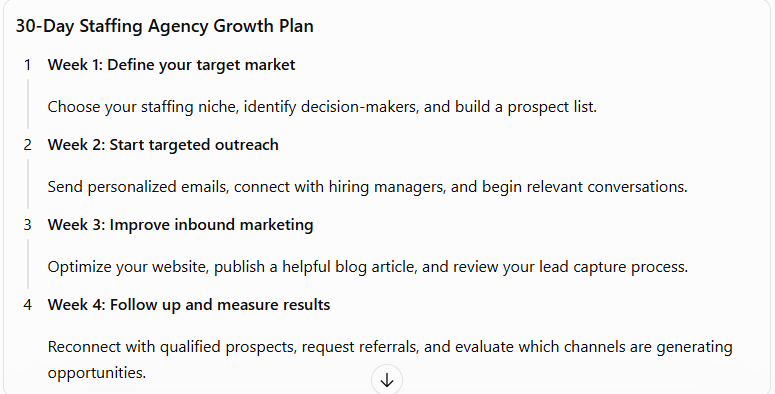
This plan is a starting framework, not a guarantee of new clients within 30 days. Adjust your activity based on your team’s capacity, sales cycle, and target market.
Building a predictable sales pipeline requires a structured approach. Learn how Seven Circles builds B2B revenue systems to support consistent prospecting and business growth.
Key Metrics Every Staffing Agency Should Track
If you want to grow your staffing agency consistently, you need to understand which activities produce results.
Track the following metrics:
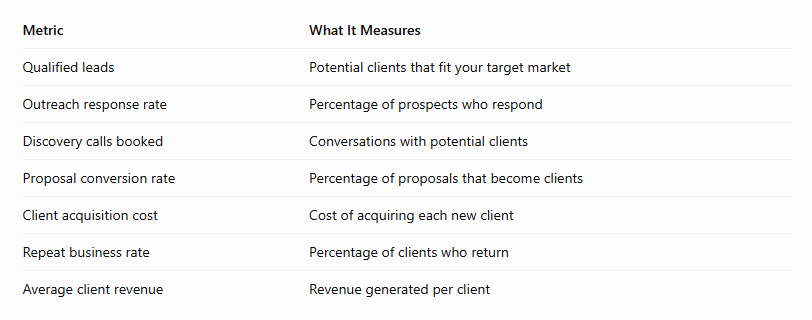
Review these numbers regularly to identify opportunities for improvement.
For example, if you receive many responses but few discovery calls, your outreach may be generating interest without clearly communicating the next step.
If you book meetings but struggle to win contracts, revisit your qualification process, value proposition, or pricing presentation.
Common Mistakes Staffing Agencies Should Avoid
Even experienced recruitment businesses can struggle with client acquisition when their approach lacks focus.
Common mistakes include targeting too many industries, relying entirely on job boards, sending generic sales messages, failing to follow up, and competing only on price.
Another mistake is focusing exclusively on finding new clients while neglecting existing relationships.
A successful staffing agency needs both an effective business development process and a reliable recruitment delivery operation.
Winning a client means little if your agency cannot consistently provide suitable candidates and professional service.
Frequently Asked Questions
How do staffing agencies find new clients?
Staffing agencies find clients through LinkedIn outreach, cold emailing, referrals, networking, SEO, industry partnerships, and researching companies with active hiring needs. The most effective approach depends on the agency’s specialization, target market, and sales process.
How can a new staffing agency get its first client?
A new staffing agency can start by choosing a specific niche, building a list of potential employers, contacting relevant decision-makers, and using existing professional relationships for introductions. Offering a clearly defined initial recruitment engagement can also help establish trust.
Is LinkedIn effective for staffing agency lead generation?
LinkedIn can be effective because it allows recruiters to identify hiring managers, research companies, and build professional relationships. Personalized outreach and consistent engagement are generally more useful than sending large volumes of generic messages.
How long does it take to get staffing clients?
The timeline varies depending on your niche, target market, reputation, outreach quality, and the employer’s hiring needs. Some opportunities develop quickly, while larger organizations may have longer procurement and vendor approval processes.
What is the best marketing strategy for a staffing agency?
There is no single best strategy for every agency. A combination of targeted outbound prospecting, SEO, referral marketing, industry networking, and client retention is a practical starting point. Measure results to determine which channels work best for your business.
Final Thoughts: How to Get More Clients for Your Staffing Agency
Growing a staffing agency requires more than contacting businesses and asking whether they need employees.
You need to understand your ideal clients, identify real hiring challenges, communicate your value clearly, and build relationships that last.
Start by selecting a niche and developing a targeted prospect list. Use LinkedIn, personalized email outreach, and industry networking to connect with decision-makers. At the same time, invest in your website, helpful content, and referral relationships to support long-term lead generation.
Most importantly, deliver excellent recruitment services to the clients you already have.
When businesses trust your agency to understand their needs and provide reliable staffing support, they have a stronger reason to work with you again.
Ready to grow your staffing agency? Start by identifying 20 qualified prospects this week, researching their hiring needs, and opening conversations that focus on how your agency can help.
Understanding how to get more clients for your staffing agency takes time, but consistent prospecting, helpful content, and excellent client service can support sustainable business growth.