
Most companies do not have a lead problem at first. They have a focus problem.
The sales team is contacting the wrong companies. Marketing is generating attention from people who will never buy. Follow-up depends on someone remembering to send the next message. The CRM contains contacts, but no one can clearly explain which prospects should receive attention today.
That is where a lead generation specialist can create value.
A strong specialist does not simply collect names, send generic emails, or fill a spreadsheet. The role connects research, targeting, messaging, outreach, qualification, and reporting so the business can consistently create conversations with the right potential buyers.
Before hiring one, however, you need to understand what the position should own, how success should be measured, and whether your company has the foundation required to support the role.
What Is a Lead Generation Specialist?
A lead generation specialist is responsible for identifying potential customers, researching the right decision-makers, initiating contact, and helping qualified prospects enter the sales pipeline.
Salesforce defines lead generation as building interest in a product or service and developing that interest toward a sale. The specialist turns that broad objective into a repeatable daily process.
Depending on the company, the role may sit within sales, marketing, business development, or revenue operations. The title can also overlap with positions such as:
- Sales Development Representative
- Business Development Representative
- Demand Generation Specialist
- Outbound Specialist
- Appointment Setter
- Prospecting Specialist
The title matters less than the actual responsibilities. A capable lead generation specialist should understand who the company wants to reach, why those buyers might care, and how to move an interested prospect toward the next appropriate step.
If your company is still deciding which channels to use, this comparison of lead generation versus traditional lead generation explains how modern, targeted outreach differs from relying primarily on referrals, events, and existing relationships.
What Does a Lead Generation Specialist Do?
The exact responsibilities vary by business model, but most effective specialists manage seven core areas.
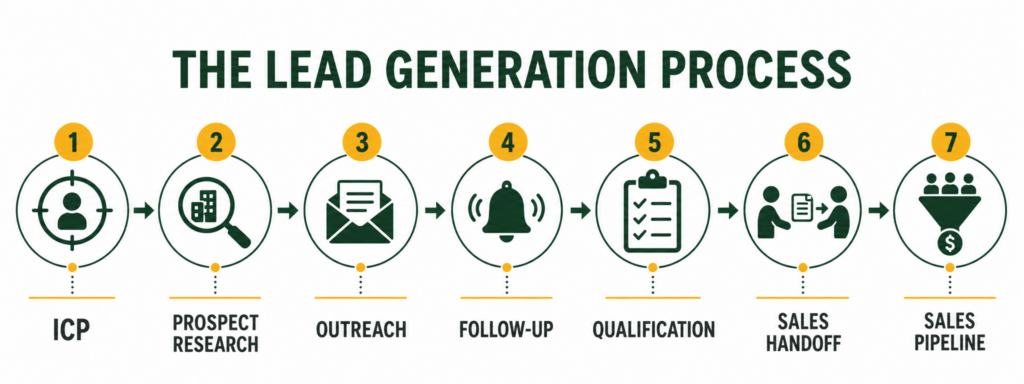
1. Define and Refine the Target Audience
Lead generation begins before anyone sends an email or makes a call.
The specialist needs a clear ideal customer profile. That normally includes:
- Industry
- Company size
- Revenue range
- Geographic market
- Business model
- Decision-maker titles
- Operational problems
- Buying signals
- Reasons the prospect might act now
Without this foundation, outreach becomes a volume exercise. The team may contact thousands of people while creating very few qualified conversations.
A lead generation specialist should also document patterns from the market. If one industry responds more frequently, one company size converts better, or one buyer title consistently owns the problem, that information should improve future targeting.
2. Build and Verify Prospect Lists
List building is one part of the job, but a useful list requires more than names and email addresses.
The specialist may use company websites, LinkedIn, industry directories, trade associations, databases, job postings, and other public signals to identify potential accounts. They should then verify that each company and contact match the targeting criteria.
A well-researched prospect record can include:
- Company name and website
- Industry and size
- Decision-maker name and title
- Verified business contact information
- Relevant business trigger
- Current tools or processes
- Personalization notes
- Outreach status
For wholesale companies, list quality is especially important because buyers evaluate factors such as supply reliability, order volume, lead times, and vendor requirements. Our guide to B2B wholesale lead generation explains how the process must adapt to wholesale buying behavior.
3. Develop Relevant Outreach Messages
Generic outreach rarely creates strong opportunities.
A lead generation specialist should be able to connect the company’s solution to a recognizable problem. That requires understanding the prospect’s situation and communicating relevance quickly.
Compare these two messages:
We help businesses grow with innovative sales solutions. Would you like to schedule a call?
And:
I noticed your team is expanding into two new markets. Companies at this stage often generate more opportunities but lose visibility once follow-up is spread across multiple people and spreadsheets.
The second message gives the prospect a reason to continue reading. It connects a visible business event to a likely operational challenge.
Strong messaging does not need to be long. It needs to be specific, credible, and aligned with the buyer’s priorities.
4. Manage Multichannel Outreach and Follow-Up
Email may be part of the process, but it should not always operate alone.
Depending on the target market, a specialist may combine:
- Cold email
- LinkedIn outreach
- Phone calls
- Social engagement
- Networking follow-up
- Event outreach
- Referral requests
- Website lead follow-up
The specialist should also manage a structured follow-up sequence. Many potential buyers do not respond to the first message because the timing is wrong, the message was missed, or another priority took over.
LinkedIn’s four-step sales prospecting plan similarly emphasizes defining the target audience and developing messaging around buyer problems before beginning outreach.
Follow-up should add context rather than repeat the same request. Each touchpoint can introduce a useful observation, resource, example, question, or new angle on the problem.
5. Qualify Leads Before Sales Conversations
More replies do not automatically mean better results.
A lead generation specialist should help determine whether a prospect is a reasonable fit before placing the opportunity on a salesperson’s calendar. Qualification may consider:
- Whether the company matches the ideal customer profile
- Whether the prospect has a relevant need
- Whether the contact influences or owns the decision
- Whether the problem is important enough to solve
- Whether the timing is realistic
- Whether the company has the capacity or budget to move forward
The purpose is not to conduct the entire sales process. It is to protect the sales team’s time and ensure that meetings have a legitimate reason to occur.
6. Hand Off Qualified Opportunities to Sales
A qualified lead needs a clear handoff. The specialist should record why the company is a good fit, what problem the buyer described, who is involved in the decision, and what next step was agreed. The salesperson can then begin the meeting with context instead of asking the prospect to repeat everything.
7. Track Performance and Improve the Process
A specialist should not be measured only by activity.
Sending 2,000 emails means very little if they reach the wrong people or create no qualified opportunities. A stronger scorecard can include:
- Accounts researched
- Verified contacts added
- Messages delivered
- Positive responses
- Qualified conversations
- Meetings accepted
- Meetings attended
- Opportunities created
- Pipeline value influenced
- Conversion by audience, message, and channel
These measurements reveal where the process is breaking. Low response rates may point to targeting or messaging. Strong response rates with few meetings may indicate a weak call to action. Many meetings with few opportunities may signal poor qualification.
Skills Every Lead Generation Specialist Needs
The best person for this role is not necessarily the person who sends the most messages. Look for a combination of research ability, commercial judgment, communication, and operational discipline.
Research and Data Accuracy
The specialist must be able to identify relevant accounts, verify information, and distinguish a genuine buying signal from a weak assumption.
Clear Business Writing
Outreach should sound human and communicate value without relying on vague claims. The specialist must write strong subject lines, opening messages, follow-ups, and calls to action.
Buyer Understanding
Effective prospecting requires an understanding of how different decision-makers evaluate problems. A CEO, sales leader, operations leader, and procurement manager may care about completely different outcomes.
CRM Discipline
Every contact, response, follow-up, and next step should be documented. Without clean CRM management, opportunities disappear and reporting becomes unreliable.
Testing and Analysis
The specialist should be comfortable testing audiences, messages, offers, channels, and timing. They should know how to interpret results without changing the strategy after every small fluctuation.
Persistence Without Pressure
Good follow-up is consistent, relevant, and respectful. A specialist needs the discipline to remain visible without damaging the company’s reputation.
Lead Generation Specialist vs. Salesperson
These roles support the same revenue process, but they usually own different stages.
A lead generation specialist typically focuses on:
- Researching target accounts
- Finding decision-makers
- Starting conversations
- Managing early follow-up
- Qualifying initial interest
- Scheduling appropriate next steps
A salesperson typically focuses on:
- Discovery
- Diagnosing the problem
- Presenting the solution
- Managing objections
- Developing proposals
- Negotiating and closing
In a small company, one person may handle both responsibilities. As the business grows, separating prospecting from closing can improve focus and accountability.
In-House Specialist, Freelancer, or Agency?
There is no universal best option. The right model depends on your strategy, resources, urgency, and internal management capacity.
Hire In-House When:
- Lead generation is a permanent daily function
- You have managers who can coach and measure the role
- Your market requires deep product knowledge
- You can support salary, tools, data, training, and ramp time
Use a Freelancer When:
- The scope is narrow and clearly defined
- You need temporary research or campaign support
- Your internal team already owns strategy and management
Work With an Agency or Growth Partner When:
- You need strategy, infrastructure, execution, and reporting
- Your CRM and follow-up process require improvement
- You want access to multiple capabilities without hiring several employees
- Your team lacks the time to build and manage the complete system
The key question is not simply, “Who can send outreach?” It is, “Who will own the entire path from targeting to qualified opportunity, and how will we know it is working?”
When Should You Hire a Lead Generation Specialist?
Hiring may make sense when:
- Referrals are no longer producing enough opportunities
- Salespeople spend too much time researching contacts
- Outreach happens inconsistently
- The company is entering a new market
- The CRM lacks a clear prospecting process
- Follow-up depends on individual memory
- Leadership cannot identify which channels create qualified pipeline
- Marketing generates attention but few sales conversations
Before hiring, make sure your offer and audience are reasonably clear. A specialist cannot fix a service that buyers do not understand or an offer that gives them no reason to respond.
If your company needs to strengthen the full foundation first, review these 10 proven strategies for generating B2B leads. They cover targeting, offers, multichannel outreach, follow-up, measurement, and the revenue leaks that can weaken results.
Common Hiring Mistakes to Avoid
Hiring for Activity Instead of Outcomes
Do not make daily message volume the only performance standard. High activity aimed at the wrong market creates noise, not pipeline.
Expecting One Person to Fix the Entire Revenue Process
A lead generation specialist can create conversations, but they cannot compensate indefinitely for weak positioning, unclear pricing, slow sales follow-up, or poor delivery.
Providing No Defined ICP
If the company cannot explain who its best customers are, the specialist will build lists based on guesses.
Launching Without Proper Infrastructure
The role needs accurate data, appropriate outreach tools, CRM stages, follow-up rules, reporting, and clear ownership once a prospect responds.
Changing Direction Too Quickly
Campaigns need enough volume and time to produce meaningful information. Constantly changing the audience, message, and offer makes it difficult to understand what is actually working.
How to Measure Success in the First 90 Days
The first 90 days should establish a functioning process, not just generate activity.
For teams building the campaign internally, HubSpot Academy’s lead generation lesson provides additional training on developing a lead generation strategy and campaign.
Days 1–30: Foundation
- Confirm the ideal customer profile
- Define buyer roles and business triggers
- Audit the offer and messaging
- Establish CRM stages and reporting
- Build and verify the first prospect segment
Days 31–60: Launch and Learn
- Begin targeted outreach
- Track delivery, replies, and qualification
- Review message and audience performance
- Document objections and market feedback
- Improve follow-up sequences
Days 61–90: Optimize
- Compare performance across segments
- Refine targeting and messaging
- Improve handoff to sales
- Identify conversion gaps
- Establish the ongoing operating rhythm
By the end of this period, leadership should understand who responds, which messages create interest, what qualifies as a real opportunity, and where the process needs further improvement.
Frequently Asked Questions
What is the main role of a lead generation specialist?
The main role is to identify relevant potential customers, reach the right decision-makers, qualify early interest, and move suitable prospects into the sales pipeline.
Is a lead generation specialist the same as a salesperson?
Not usually. The specialist generally focuses on prospecting and qualification, while the salesperson manages discovery, proposals, negotiation, and closing. Small companies may combine both roles.
What tools does a lead generation specialist use?
Common tools include a CRM, LinkedIn, contact databases, email-verification platforms, outreach software, analytics dashboards, and industry-specific research sources. The process matters more than any individual tool.
How quickly should a lead generation specialist produce results?
Early activity and market feedback can appear within weeks, but qualified pipeline depends on the sales cycle, audience, offer, data quality, channel, and follow-up process. The first 90 days should be evaluated as a structured build, launch, and optimization period.
Can a lead generation specialist guarantee meetings or sales?
No responsible specialist can guarantee buyer behavior. They can guarantee disciplined execution, accurate targeting, consistent outreach, follow-up, reporting, and continuous improvement.
A Specialist Needs a System to Succeed
A lead generation specialist can become an important part of your growth strategy, but the title alone solves nothing.
The person needs a defined market, a credible offer, relevant messaging, reliable data, clear qualification standards, organized follow-up, and a sales team prepared to handle the opportunities they create.
When those elements work together, lead generation becomes more than sending messages. It becomes a disciplined process for creating and developing the right business conversations.
Seven Circles System LLC helps B2B companies identify gaps across targeting, positioning, outreach, follow-up, CRM management, and pipeline conversion. If your team is considering hiring a lead generation specialist but the underlying process is still unclear, start by mapping the system the person will be expected to operate.
Ready to identify the gaps in your current lead generation process? Contact Seven Circles System LLC to discuss your targeting, outreach, and pipeline infrastructure.