
Your best clients still come from someone who knew someone. That is traditional lead generation, and it built your business up to a real ceiling. Lead generation vs traditional lead generation is not a question of which one is smarter, it is a question of who initiates the relationship and how repeatable that initiation is.
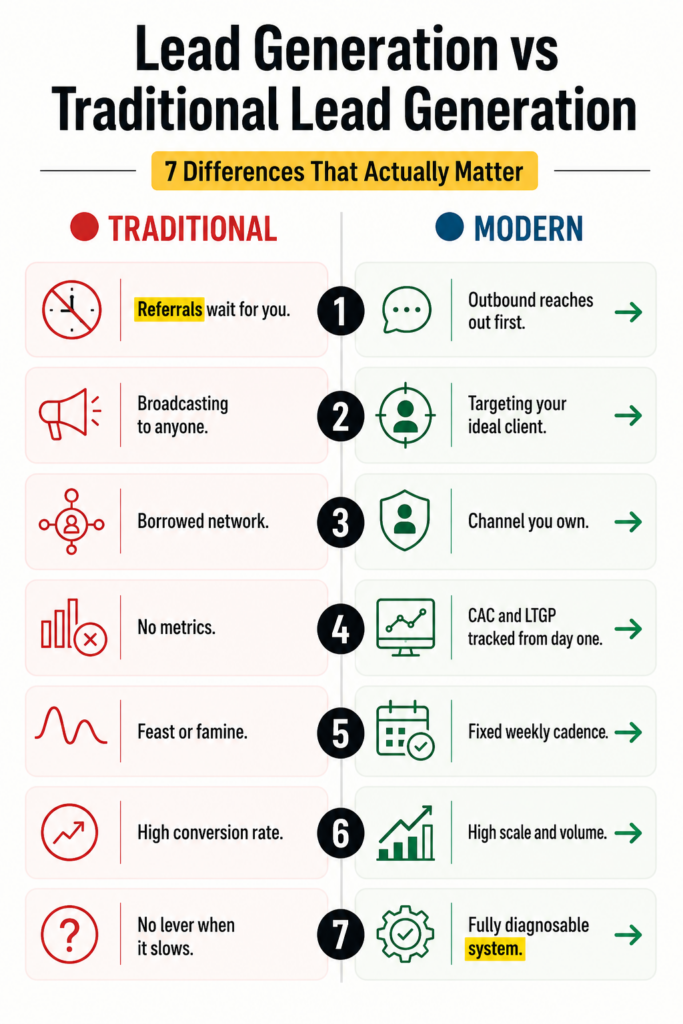
Traditional lead generation depends on relationships you already have. Modern lead generation builds relationships with people who do not know you yet, on a schedule you control. Here are the seven differences that actually matter when you compare lead generation vs traditional lead generation side by side.
What Is the Difference Between Traditional and Modern Lead Generation?
Traditional lead generation often uses referrals, events, and existing relationships to find buyers. Modern B2B lead generation also uses targeted outreach and digital channels to start new conversations. Service businesses can use both; the right mix depends on their buyers and sales capac
1. Who Starts the Relationship
Traditional lead generation runs on channels that require someone else to think of you first. Referrals, word of mouth, trade shows, and repeat business from existing clients all fall into this category. Modern lead generation flips that. You identify exactly who should be talking to you, and you reach them first instead of waiting.
This single difference between lead generation and traditional lead generation explains almost everything else on this list.
2. Targeting Versus Broadcasting
Traditional lead generation broadcasts to whoever shows up: whoever attends the trade show, whoever picks up the cold call, whoever happens to need a referral that week. Modern lead generation starts from an ideal client profile and works backward, defining company size, industry, and buying signals before a single message goes out.
This is why outbound prospecting for service firms looks different today than it did a decade ago. Tools that filter down to the exact founder or operator who fits your profile replace the old approach of hoping the right person is in the room.
3. Ownership of the Channel
A referral network is not something you own. It is something you depend on, and dependency is the core weakness in referral-based growth. If your top referral source retires or gets busy, that pipeline shrinks with no warning.
Modern lead generation runs through channels you control directly, your own outbound sequences, your own outreach list. You can turn volume up or down based on capacity instead of finding out at the end of a slow quarter that referrals dried up.
4. Forecasting and Metrics
Traditional lead generation is nearly impossible to forecast because there is no consistent unit economics attached to a referral. You cannot calculate a cost of acquisition on a lead that showed up because a client mentioned you at dinner.
Modern lead generation gets measured the way any repeatable system gets measured. Customer acquisition cost against lifetime gross profit tells you whether the motion is worth running. Average contract value against the effort required to close it tells you whether you are targeting the right tier of client. HubSpot’s guide to sales pipeline management covers how teams attach real numbers to a process instead of guessing.
5. Consistency Versus Feast or Famine
Referrals arrive in clusters, then go quiet for no predictable reason. Modern lead generation runs on a fixed cadence regardless of how referrals are performing that month. Pipeline consistency in a modern lead generation motion comes from that cadence running in the background, not from remembering to reach out when business feels slow.
That consistency is the entire point. A system that only works when you remember to use it is not a system, it is traditional lead generation wearing new software.
6. Conversion Speed Versus Conversion Rate
Referrals convert at a high rate because trust is already built into the introduction. Modern lead generation converts slower per contact because the relationship starts cold, but it scales because volume is not capped by how many people happen to know you.
Neither wins outright in the lead generation vs traditional lead generation comparison. Referrals win on rate, modern lead generation wins on scale and predictability.
7. What Happens When It Slows Down
This is the difference that actually matters day to day. When a referral channel slows down, there is no lever to pull. You wait. When a modern lead generation system slows down, you can diagnose it: list quality, message performance, targeting fit, and adjust.
Founders who stall are the ones with nothing running underneath the referral channel. When referrals go quiet, pipeline goes quiet with them, because there was never a second engine behind the traditional lead generation approach.
Where the Two Actually Overlap
Lead generation vs traditional lead generation is not really an either-or choice. Referrals still convert well and no founder should turn that channel off. The real comparison is about what fills the gap between referrals, not about replacing referrals entirely.
If you want the step by step breakdown of how to actually build the second engine, how to generate leads walks through the full system founders use to stop depending on referrals alone.
The Real Question to Ask Your Business
Instead of asking which approach is better, ask a narrower question: what happens to your pipeline if referrals stop for ninety days? If the honest answer is “it collapses,” you are running on traditional lead generation with no system behind it, and the lead generation vs traditional lead generation debate has already answered itself for you.
Where This Leaves You
Traditional lead generation is not wrong, it is incomplete. It gives you a channel with no lever to pull when it slows down. Modern lead generation gives you the second engine, a system built around your actual ideal client profile, running on a schedule instead of luck, with metrics attached from day one.
If your pipeline depends entirely on people remembering you exist, the next step is building the system that runs underneath that, so referrals become one input instead of the whole business in your lead generation strategy.
Want to build a lead generation system alongside your referrals? Explore Seven Circles’ services.